
Your Organisation Already Has the Knowledge. Now It Can Use It.
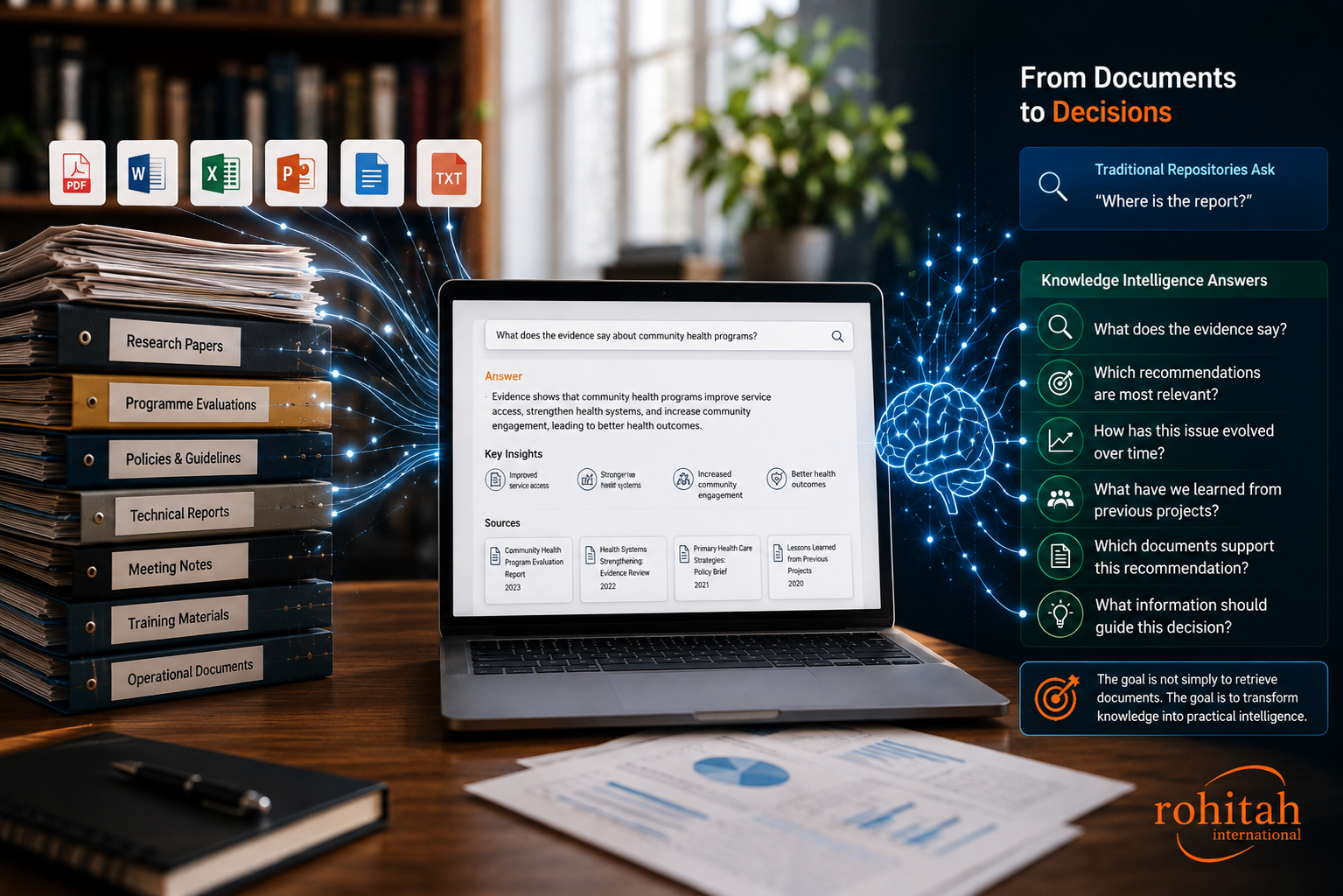
Every organisation accumulates thousands of documents over time—technical reports, research papers, programme evaluations, policies, guidelines, meeting notes, training materials, and operational documents. Together, they represent years of institutional knowledge, yet much of this valuable information remains difficult to access when it is needed most.
Knowledge Intelligence transforms these distributed information assets into an intelligent knowledge ecosystem, allowing users to ask questions in natural language and receive context-rich, evidence-based answers drawn from trusted sources.
 Institutional Knowledge
 Evidence-Based Answers

Organisations today face an abundance of information but a shortage of accessible knowledge.
Critical evidence often exists across hundreds or thousands of documents, stored in different locations, written by different teams, and created over many years. Finding the right information can take hours—or it may never be found at all.
Knowledge Intelligence helps organisations transform scattered information into a living, searchable knowledge ecosystem that supports research, programme implementation, policy development, and evidence-informed decision-making.
Artificial Intelligence is only as valuable as the knowledge it can access. Knowledge Intelligence is built upon three principles.
Reliable answers begin with reliable sources. The platform is designed around trusted documents rather than unrestricted internet content.
Every report, guideline, evaluation, and project document contributes to the organisation's growing knowledge base. Knowledge should accumulate—not disappear.
Knowledge ecosystems evolve. As new evidence becomes available, authorised users can expand and enrich the knowledge environment for future users.
Access to information is always governed by user permissions and organisational policies.
Knowledge Intelligence helps users move beyond document search by transforming information into practical answers.
Locate relevant information across extensive document collections without manually reviewing individual reports.
Interact with your knowledge base using everyday language instead of complex keyword searches.
Create concise summaries from multiple trusted sources while preserving the underlying evidence.
Quickly identify supporting literature, technical guidance, historical reports, and implementation experiences relevant to your research questions.
Access previous proposals, programme documents, donor guidance, and technical evidence to support high-quality proposal writing.
Ensure that valuable organisational knowledge remains available even as teams, projects, and personnel change over time.
Explore similarities and differences across guidelines, policies, frameworks, and technical recommendations from multiple trusted sources.
Reduce the time required to find relevant information while improving confidence in evidence-informed decisions.
Knowledge Intelligence supports organisations that depend on reliable information every day. Typical users include:

Knowledge Intelligence is not a static document repository.
As new reports, publications, guidelines, and technical documents become available, authorised users can continuously enrich the knowledge ecosystem. Every contribution strengthens future searches. Every new document expands institutional intelligence.
Over time, the platform evolves into a continuously improving knowledge resource that reflects both global evidence and organisational experience.

Traditional Repositories Ask"Where is the report?"
Knowledge Intelligence answers much more important questions:
Future capabilities may include:
The platform will continue to evolve as organisations contribute new knowledge and new evidence.
Knowledge Intelligence is the intelligence layer within Rohitah Solutions. Together, the ecosystem supports the complete journey from data to decisions.
Each solution strengthens the next. Together they create an integrated evidence ecosystem.
No. It is an evidence-informed knowledge platform that retrieves information from trusted organisational and public knowledge sources to support more reliable answers.
Yes. Organisations can build private knowledge environments using their own reports, policies, guidelines, technical documents, and other approved resources.
No. Knowledge Intelligence complements existing repositories by making their content easier to search, understand, and apply.
Yes. Knowledge environments can be configured with user-specific access controls, ensuring that confidential information is only available to authorised users.
Every report, every evaluation, every guideline, and every lesson learned represents an investment in knowledge. Knowledge Intelligence helps organisations unlock that investment by transforming information into accessible, trusted, and actionable intelligence.
Explore IntelligenceRohitah Solutions is an Innovation Lab for Evidence Intelligence, developing evidence systems that strengthen data collection, data quality, evidence integration, and decision support across research, public health, and development. Powered by responsible AI and grounded in practical implementation experience, every solution contributes to a shared mission of better evidence and better decisions.